





![SYNVISC_ONE_6ML[1]](https://cosmodirectsupply.com/wp-content/uploads/2024/02/SYNVISC_ONE_6ML1-e1721064024562-100x100.png.webp)












Radiesse and Sculptra are two of the most established collagen-stimulating injectables on the aesthetic medicine market. The two share one goal: restoring structure through the body’s own collagen response. However, while they seem similar, they are not identical, which makes the choice of Radiesse vs Sculptra more complex.
Composition and the Cellular Basis of Each Filler’s Effect
Radiesse and Sculptra both fall into a category of biostimulators, with mechanisms of action quite different from regular hyaluronic acid fillers. Their primary long-term effects include skin tightening and improved texture and volume, achieved by stimulating natural collagen production. Still, not all biostimulators are built the same.
Particle Size and Carrier Chemistry
Radiesse consists of CaHA microspheres, 25-45 microns in diameter, in a carrier gel made from sterile water, glycerin, and sodium carboxymethylcellulose (CMC). The formulation is roughly 30% CaHA to 70% gel by volume. It comes pre-mixed and ready to inject.
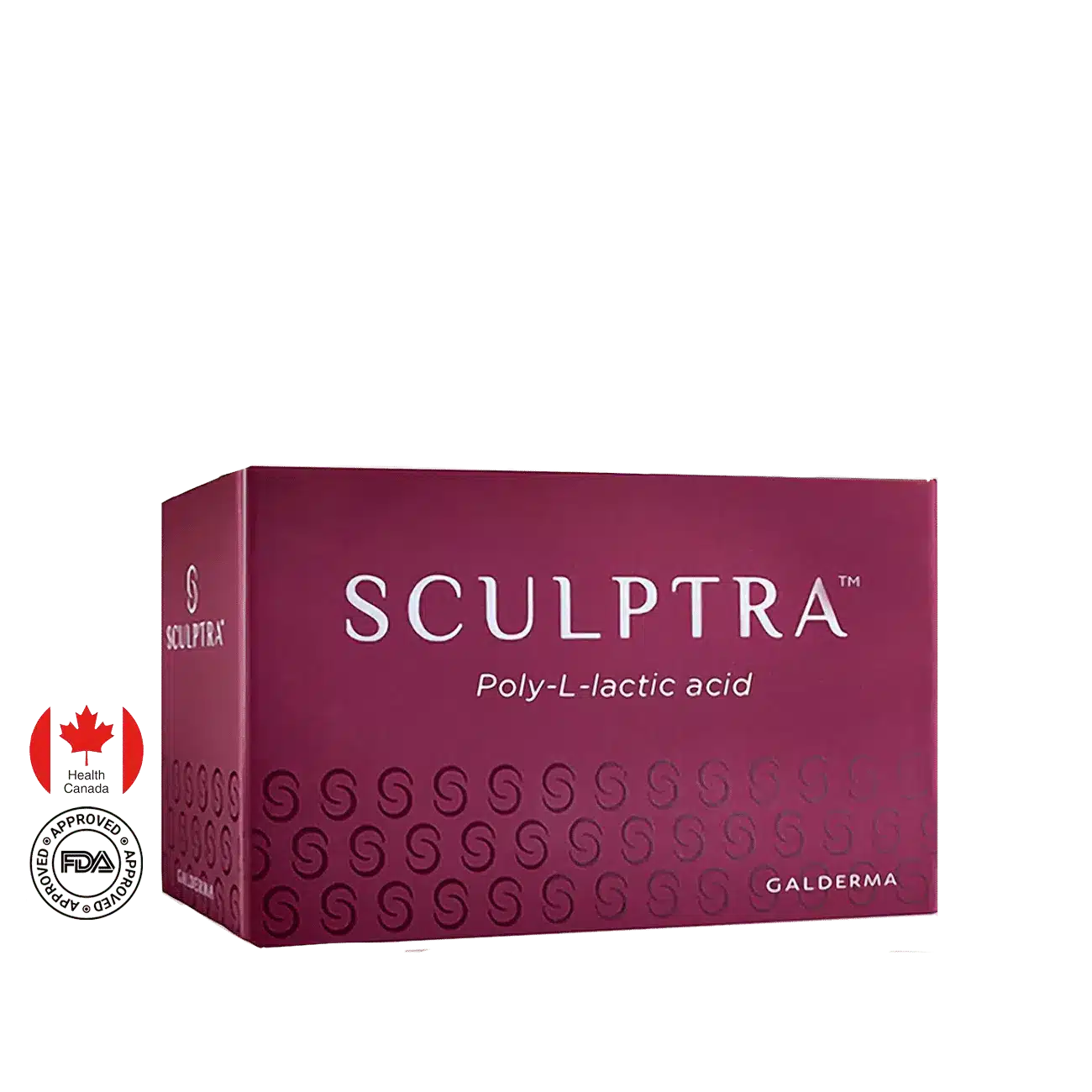
Sculptra’s microparticles are slightly larger. They come as a freeze-dried powder in sodium carboxymethylcellulose and mannitol that must be reconstituted with sterile water before use.
|
Attribute |
Radiesse (CaHA) |
Sculptra (PLLA) |
|
Active particle |
Calcium hydroxylapatite microspheres |
Poly-L-lactic acid microparticles |
|
Particle size |
25–45 microns |
~50 microns |
|
Carrier |
Aqueous CMC and glycerin gel |
Freeze-dried powder, reconstituted before use |
|
Immediate volume from carrier |
Yes |
No |
|
Manufacturer |
Merz |
Galderma |
Radiesse’s gel adds clearly visible volume instantly after it’s injected. Over the following weeks, the body gradually resorbs the carrier, and the remaining CaHA microspheres act as a scaffold. Then fibroblasts attach to that scaffold and begin depositing type I collagen around it. This is what sustains the results once the original gel volume is gone.
Sculptra’s effects are based solely on a biological response. The PLLA particles trigger a controlled inflammatory reaction. Macrophages surround the particles, leading to a signalling cascade that recruits fibroblasts to the treated area over several weeks. This response builds gradually and compounds over multiple sessions, which is why Sculptra results become visible over time and not right after the first treatment is done.

Practical Difference
Radiesse boosts collagen production through calcium hydroxylapatite (CaHA), a mineral compound chemically identical to the inorganic component of human bone. Sculptra achieves this through poly-L-lactic acid (PLLA), a biodegradable polymer with a long history in resorbable surgical sutures.
The main difference is in the mechanism, which directly affects the results.
Radiesse acts as a dual-mechanism product. It adds volume right away, so the patient can see the result immediately after the appointment. However, this instant result is also followed by a prolonged effect of collagen stimulation.
Sculptra has no such immediate “filler-like” effect. It’s a straightforward biostimulator in its purest form and will only show its effects gradually in the following weeks. This doesn’t make one worse than the other. In fact, pure biostimulators like Sculptra have been rising in popularity year over year. This just makes the options you can offer your clients a bit broader.
Radiesse vs Sculptra and What the Clinical Trial Data Shows
The mechanism differences above are backed by two very different kinds of clinical evidence, one built around a single pivotal trial and one built around a body of studies across a treatment series.
The Radiesse Pivotal Trial and Long-Term Follow-Up
Radiesse’s original FDA approval was based on a multicenter split-face trial involving 117 people with moderate to deep nasolabial folds. Each participant received Radiesse on one side of the face and human collagen on the other. Over six months, blinded evaluators rated the Radiesse-treated side as superior in 79% of participants.
A separate long-term follow-up study tracked 102 of these participants for up to 39 months. It found that 40% of the treated folds and wrinkles were still visibly improved at least 30 months after injection. No nodules, granulomas, or infections were reported during the follow-up period.
The Sculptra Evidence Base Across a Treatment Series
Published studies on poly-L-lactic acid biostimulators consistently confirm a gradual increase in dermal thickness and collagen density over the months following each session. Clinical improvement usually becomes visible 4 to 8 weeks after a session and continues to build with more sessions. Results most often are visible for up to 2 years.
Regulatory History as a Proxy for the Evidence Base
An FDA approval timeline is a reasonable stand-in for how much clinical evidence a product has accumulated, since each new indication requires its own trial data. Laid out chronologically, the two products’ approval histories interleave rather than run in parallel.
A Combined FDA Timeline
These injectables have come a long way since first hitting the market. Gradually, the FDA approved both for more and more indications.
2004: Sculptra Approved for HIV-Associated Lipoatrophy
The FDA’s first clearance for injectable Poly-L-lactic acid was to use it for lipoatrophy or facial fat loss in patients with HIV.
2006: Radiesse Approved for Nasolabial Folds and Wrinkles
Merz’s pivotal split-face trial became a foundation for Radiesse’s approval for moderate to severe facial wrinkles and folds. This indication is the one that practices still associate with the product the most.
2009: Sculptra Expanded to Nasolabial Folds and Facial Wrinkles
Sculptra get approved for correction of nasolabial folds and facial wrinkles. Transition from a narrow medical indication into general aesthetic medicine use.
2015: Radiesse Approved for Hand Augmentation
Radiesse becomes the first dermal filler approved for dorsum volume loss. The decision was based on a controlled trial in which 75% of treated patients showed improvement at 3 months.
2023: Sculptra Approved for Cheek Wrinkles
Galderma’s Sculptra cheek wrinkle approval added a second facial indication for Sculptra, backed by its own randomized trial data. This confirmed that the product’s aesthetic use can extend beyond the nasolabial area.
2026: Radiesse Approved for Décolleté Wrinkles
Radiesse’s newest approval, granted in April 2026, makes it the only dermal filler with an on-label FDA indication for the décolleté, an area both products are already used to treat off-label.
Both products started with a narrower indication and widened their approved use as more trial data came in. This confirms their reputation doesn’t rest on marketing alone. Radiesse’s four indications now include the facial area, hands, and, as of 2026, the chest area as well. Sculptra’s three indications span facial fat loss and two categories of facial wrinkles.

Treatment Area Selection: Matching Product to Tissue Behaviour
The choice between the two products for a specific area depends mostly on tissue thickness and mobility than on brand preference.
Structural Zones: Cheeks, Jawline, and Chin
Cheeks, jawline, and chin are the zones where practitioners often lean towards Radiesse. These thicker tissues benefit more from Radiesse’s immediate volumizing effect and structural lift.
Thin and Mobile Zones: Temples, Décolletage, and Hands
Thinner or more mobile tissue tends to respond better to a product that builds volume gradually. Temples, the décolletage, and the backs of the hands are the areas where Sculptra’s gradual collagen buildup tends to work best, offering the most natural-looking result.
Overlap Zones: Nasolabial Folds and Marionette Lines
Nasolabial folds and marionette lines sit in the overlap. Both products have trial data supporting their use in these areas. In practice, the choice mostly depends on the client and whether they want to see quick results or can wait to see the change.
Safety Profile and Patient Selection
The possible side effects for both biostimulators are the same as for many other injectables and include temporary swelling, redness, and bruising at the injection site. The symptoms usually resolve on their own within a week. Both should also be avoided in anyone with known hypersensitivity to a formulation component.

A Decision Framework for Clinical Practice
The trial data, regulatory history, and mechanism above translate into a fairly clear set of decision criteria. The table below summarizes which factors tend to favour each product in a treatment plan.
|
Clinical Factor |
Radiesse |
Sculptra |
|
Patient wants visible change at the appointment |
+ |
|
|
Patient wants a gradual, hard-to-detect result |
+ |
|
|
Deep, structural fold or volume loss |
+ |
|
|
Broad, diffuse volume loss treated over a series |
+ |
|
|
Longest possible duration is the priority |
+ |
|
|
Single-session treatment plan preferred |
+ |
Clinics and practitioners can order Radiesse or Sculptra wholesale from reputable aesthetic medicine suppliers, such as Cosmo Direct Supply, and benefit from lower bulk order prices.
Final Decision Between Radiesse vs Sculptra
The Radiesse vs Sculptra choice ultimately comes down to the specific case. These two have different evidence bases built for two different clinical timelines, both FDA-approved for various indications. Neither evidence base makes the other product obsolete, so having both stocked simply improves the quality of your service for a higher percentage of patients.
Radiesse vs Sculptra FAQ
-
Why does Sculptra take longer to show results than Radiesse?
This happens because Sculptra doesn’t contain a gel carrier. Its PLLA particles stimulate fibroblasts to produce collagen over several weeks, so a visible result develops gradually.
-
Do Radiesse and Sculptra have different FDA-approved uses?
Yes, Radiesse is FDA-approved for nasolabial folds and facial wrinkles, hand treatment, and, as of April 2026, décolleté wrinkles. Sculptra holds FDA approval for facial lipoatrophy, nasolabial folds, facial wrinkles, and cheek wrinkles.
-
Where can I buy Radiesse and Sculptra online?
Licensed clinics, medispas, and practitioners can buy Radiesse as well as Sculptra online through Cosmo Direct Supply at wholesale prices, with both product lines shipped from the same order. Cosmo Direct Supply works directly with manufacturers to provide the best prices and high-quality, original injectables.
-
Is Radiesse better than Sculptra?
In some cases, Radiesse would be a better option, whereas in others it’s best to choose Sculptra. If the patient wants to see the difference right after the injection, then it’s worth considering Radiesse. If they’re aiming for a gradual, prolonged effect, then it’s something Sculptra can provide. Having all the options at hand means you can offer exactly what your client needs.

 Dermal Fillers
 Skincare
 Live Chat
 My account