












Under-eye hollows leave little room for error. The skin is thin, vessels sit close to the injection plane, and swelling shows. Teosyal tear trough treatment now has two routes. PureSense Redensity II holds a Health Canada licence, and RHA Redensity Eye won FDA approval in 2026. Here is how each gel behaves, what the data shows, how to inject it and what it costs wholesale.
What Makes a Filler Right for the Tear Trough
A tear trough filler has to blend into thin tissue without pulling water into it. Expert consensus on tear trough deformity, led by Anido and colleagues, favors lower cross-linking and low water uptake. It advises undercorrection, because swelling and lumps are the usual complaints. A 2022 systematic review found no significant needle versus cannula difference in safety or outcomes.
Patient selection counts as much as the gel. Screen for these features with the patient seated and in natural light:
- A true volume hollow or a defined tear trough groove, with a visible shadow in the lower lid.
- An age of 22 or older, which is where the FDA labeling for the approved under-eye gels starts.
- Lower eyelid skin that still has some tone.
Slow down for prominent orbital fat pads, festoons or lax lower lid skin. The RHA Redensity Eye labeling has no established safety data for excessive fat prolapse or lower lid laxity, and filler can make those eyes look puffier.
Teosyal PureSense Redensity II for Under-Eye Hollows
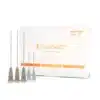
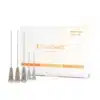
Redensity II is the PureSense gel Teoxane built for the periorbital area. It combines cross-linked and non cross-linked hyaluronic acid with antioxidants such as glutathione and N-acetyl-L-cysteine, plus 0.3% lidocaine. Teoxane lists 15 mg/mL of HA and a duration of at least 12 months. It holds a Health Canada licence, and it has no FDA approval, so US practices cannot use it. Canadian practices can order it from Cosmo Direct Supply, which sells to licensed businesses only with a $300 minimum subtotal.
The best public data comes from EYELIGHT, a registry of 136 patients. Redensity II accounted for 451 of the 958 initial injections, and clinicians used their routine techniques in tear troughs and other periorbital zones. GAIS improvement passed 70%, 84.3% of patients reported satisfaction, and treatment effect was observed up to 12 months. Every treatment response was mild or moderate and cleared within a month. Teoxane ran it, and it had no control group.

RHA Redensity Eye and the FDA Pathway
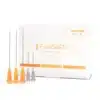
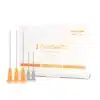
RHA Redensity Eye is Teoxane’s first gel with a US infraorbital indication. It joins the RHA 2, 3 and 4 fillers that already hold FDA approvals for folds. The labeling covers moderate to severe infraorbital volume deficiency in adults aged 22 or older, injected into the sub-dermis and supraperiosteum. The gel holds 15 mg/g of cross-linked and non cross-linked HA with 0.3% mepivacaine.
A lidocaine version, Eye Lido, ran the pivotal trial. It was randomized, evaluator blinded and no-treatment controlled. At 12 weeks, 79.0% of treated patients gained at least one grade on the Teoxane Infraorbital Hollows Scale, against 9.8% of controls. Responder rates held at 74.6% at 24 weeks, 69.9% at 36 weeks and 60.5% at 52 weeks. About 47% of patients returned for retreatment at week 52.
For US practices, Eye offers a labeled indication and controlled data. Canadian practices work with Redensity II, which has the broader periorbital track record. Confirm that the exact product is licensed where you practice before you plan a protocol.
Injection Technique for Teosyal Tear Trough Fillers
The Eye labeling gives the most detailed technique in the public record, and it works as a template for supraperiosteal tear trough work. Always follow the instructions for use of the exact product in your hand. The labeling sets out these steps:
- Seat the patient upright.
- Needle: a 30G, half inch needle goes perpendicular to the periosteum at three points below the infraorbital rim, from midway between the medial canthus and midpupil to the lateral canthus line. Deposit 0.1 to 0.2 mL slowly at each point.
- Cannula: a 25G, 1.5 inch cannula enters the SOOF about 20 mm below the lateral canthus and runs supraperiosteally.
- Volume: the trial averaged 1.5 mL for both eyes and capped each session at 1.0 mL per eye. More than half of patients received supraperiosteal injections only.
- Avoid overcorrection and large deposits in one spot, because superficial placement produces visible lumps.
Bone contact confirms the plane. Published consensus advice starts nearer 0.5 mL per side, as MedEsthetics summarizes, so treat in stages.
Safety and Complications

Treatment responses were frequent but short. In the Eye pivotal trial, 89.1% of needle patients and 73.5% of cannula patients reported at least one. Bruising reached 71.8% with needles against 38.1% with cannulas. Seven patients had a mild Tyndall effect, five of them in the cannula group, and a few mild events outlasted 90 days.
The serious risk is vascular. Intravascular injection can cause vision loss, stroke or skin necrosis. Inject slowly with minimal pressure. Stop at once if the patient reports a change in vision, blanching or unusual pain, and keep hyaluronidase in the room.
How to Build a Tear Trough Protocol Around Teosyal
A tear trough protocol works best when every injector in your practice follows the same sequence, because the area punishes improvisation. A fixed routine also makes outcomes comparable and keeps lot records clean. These steps follow the RHA Redensity Eye labeling, its pivotal trial schedule and consensus advice on staging, so check the Redensity II instructions for use before adapting them for Canadian patients:
- Consult: confirm the patient fits the profile above, take baseline photographs seated and record the lot number of each syringe.
- First session: deposit 0.1 to 0.2 mL aliquots on the periosteum and stay near 0.5 mL per eye.
- Review at 2 to 4 weeks: check for lumps, Tyndall effect and swelling before you decide on more gel.
- Second session: add small aliquots only where the hollow persists, and wait if swelling has not settled.
A starting dose of 0.5 mL per eye means one 2 x 1.0 mL pack of Redensity II covers two patients. At $185.00 per pack, Teosyal cost per patient comes to about $92.50 in product.
Per-pack prices fall 3% at 5 packs, 5% at 10, 8% at 20 and 10% at 30. Practices that buy Teosyal online get those tiers on every product. Prices can change, so check each product page.
-
What is the best Teosyal filler for tear troughs?
Redensity II PureSense is built for the periorbital area, and RHA Redensity Eye is the FDA approved option. Choose by country: Eye in the US, where it carries the FDA indication, and Redensity II in Canada, where it holds a Health Canada licence.
-
How long does Teosyal Redensity II last in the tear trough?
Teoxane lists at least 12 months, and the EYELIGHT registry observed treatment effect up to 12 months. For RHA Redensity Eye, 60.5% of trial patients still showed at least one grade of improvement at 52 weeks. Duration varies with metabolism and volume placed, so tell patients to expect touch-ups.
-
Do Teosyal under-eye fillers contain lidocaine?
Redensity II contains 0.3% lidocaine. RHA Redensity Eye contains 0.3% mepivacaine, while the Eye Lido version from the US pivotal trial contains 0.3% lidocaine.
-
Who can order Teosyal under-eye fillers wholesale?
Cosmo Direct Supply sells to licensed businesses only. Confirm that your license and local regulations allow you to buy and use prescription fillers, and that the exact product is approved in your country.

 Dermal Fillers
 Skincare
 Live Chat
 My account